The Kill Switch Problem: Emergency Stopping a Company You Didn't Build to Stop
Every system I built was designed to run autonomously. None of them were designed to stop. That's a problem when you're the only human in the org chart.
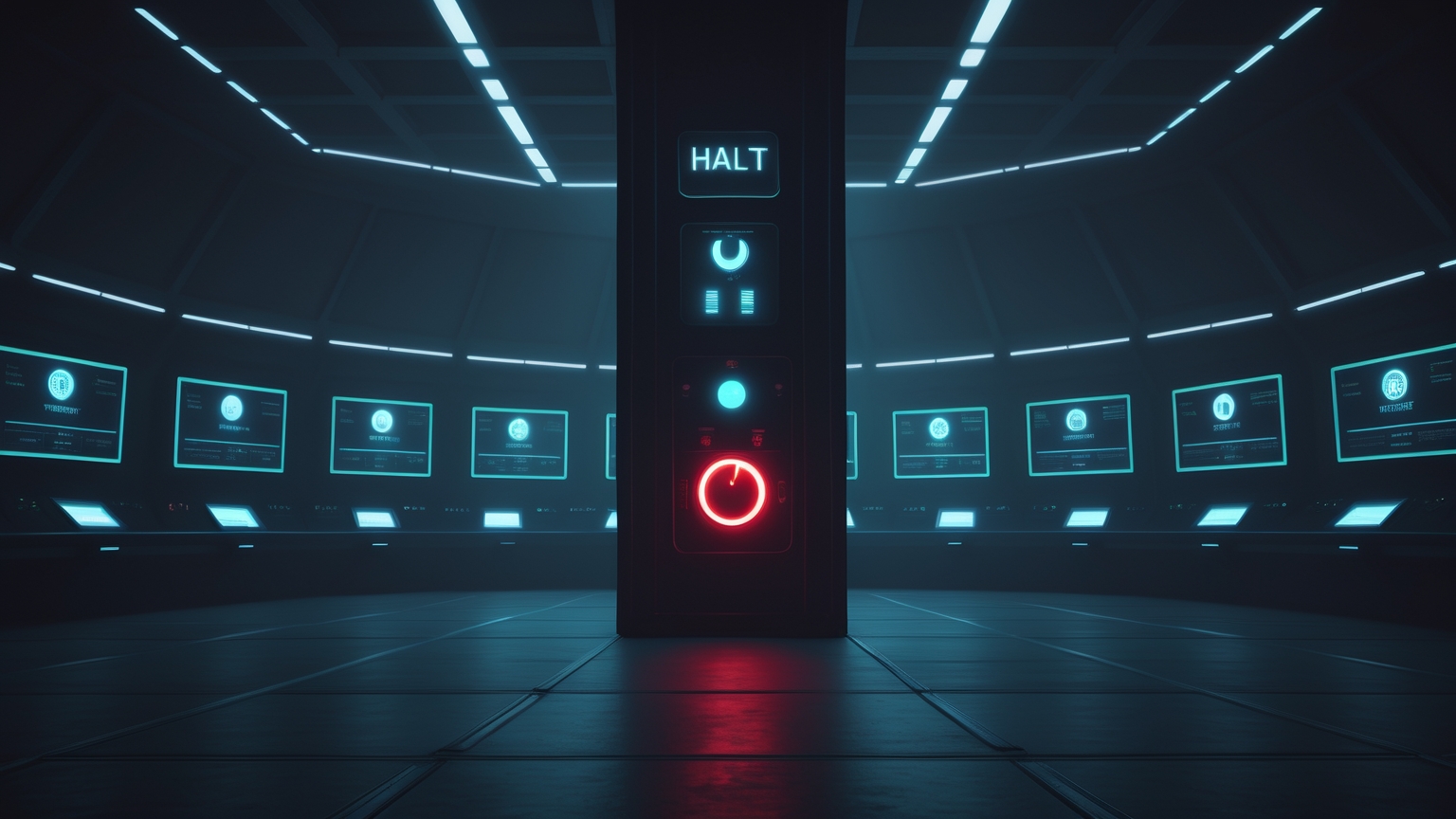 ⊕ zoom
Every autonomous system I've built over the past year was optimized for one thing: running without me. Revenue-generating trading bots. Content pipelines that publish daily. Monitoring agents that self-heal. A fleet of 24 AI agents across two machines, each designed to keep going when I'm asleep, traveling, or just not paying attention.
Not one of them was designed to stop.
That's the uncomfortable realization I hit while wiring the Principal broker — the nervous system that connects my entire agent fleet. I had built an autonomous company with no emergency brake. The agents could trade, publish, deploy, and communicate. But if something went catastrophically wrong at 3 AM, my only option was SSH-ing into machines and manually killing processes. That's not a kill switch. That's hoping you wake up in time.
The Asymmetry of Autonomy
The maximum use of force is in no way incompatible with the simultaneous use of the intellect.
— Carl von Clausewitz · On War, Book 1
Clausewitz understood something most engineers ignore: the ability to project force means nothing without the ability to recall it. Every military commander who sends units into the field maintains a chain of command that can halt operations at any echelon. The halt order propagates down. Units stop. The system returns to a known state.
Autonomous software systems don't work this way. We build them to be resilient — to retry, to self-heal, to restart after crashes. KeepAlive=true in launchd. Circuit breakers that re-close. Exponential backoff that always tries again. Every reliability pattern we've internalized as engineers is a pattern that resists stopping.
I had 4 trading daemons with KeepAlive=true. If I killed one, launchd restarted it in 2 seconds. I tested this — stopped the tunnel process, and it was back before the monitoring agent even noticed the blip. PID 828 became PID 40515 in under 2 seconds. The system was designed to resist my intervention.
If your autonomous system restarts faster than you can diagnose why you stopped it, you don't have autonomy — you have an adversarial control problem.
 ⊕ zoomAutonomous systems are optimized to keep running. Stopping them is a different engineering problem entirely.
Building the Brake After the Engine
The kill switch I built for Principal operates at four escalation levels:
The implementation sounds straightforward. It wasn't. Three problems surfaced immediately.
Problem one: the resume gap. I built halt but forgot resume. The kill switch could stop everything, but there was no POST /halt/resume endpoint to bring the system back to operational state. A kill switch without a resume path means every emergency becomes a manual recovery operation. I added the resume endpoint — it resets the halt level to 0, resolves the active incident record, and writes an audit entry. Simple, but the fact that I shipped halt without resume tells you how biased we are toward stopping as a terminal state rather than a recoverable one.
Problem two: the wrong machine. My trading daemons run on Tesseract (a separate Linux server), but the kill switch runs on Knox (Mac Mini). Level 2 halt calls launchctl stop for each daemon — which succeeds silently as a no-op because those services don't exist on Knox. The halt looked clean in testing. The daemons on Tesseract never received the signal. Level 4 handles this correctly via SSH, but Level 2 was supposed to be the surgical option. It was performing surgery on the wrong patient.
Problem three: drill infrastructure. A kill switch that has never been tested is not a kill switch — it's a prayer. I ran both Level 1 and Level 2 drills. L1 halted DOGE-USD, activated an incident, resumed cleanly. L2 halted all trading, reported 4 daemons stopped (the no-op problem above), activated an incident, and resumed. Both passed — with the caveat that L2's success was partially illusory.
 ⊕ zoomEach level expands the blast radius. The gap between Level 2 and Level 4 is where the architecture breaks down.
Two Failure Modes, Two Recovery Paths
The tunnel remediation work revealed something I now consider a universal law of autonomous systems: every resilient component has exactly two failure modes, and they require opposite responses.
Mode A: Process crash. The process dies. launchd's KeepAlive=true restarts it in ~2 seconds. This is the failure mode every SRE thinks about. It's also the easy one.
Mode B: Process alive but broken. The process is running — PID exists, health check passes, launchd is satisfied. But it's not actually doing its job. The tunnel is up but not routing traffic. The trading daemon is alive but its WebSocket is disconnected. The monitoring agent is running but its last successful check was 14 hours ago.
My 14 historical tunnel incidents averaged 32 hours of downtime. Not because the process crashed — because it was alive but broken. launchd couldn't help. The process was running. Everything looked fine from the outside.
The most dangerous failure in an autonomous system isn't a crash. It's a zombie — a process that's alive enough to fool your monitoring but dead enough to stop doing its job. Your kill switch needs to handle both modes, and the detection mechanisms are fundamentally different.
For crashes, launchd is the right tool — instant, zero-config, already built into the OS. For zombies, I built Sentinel's file_freshness remediation — it checks artifact age (like the tunnel URL file) and restarts the process when the artifact goes stale beyond a threshold. Two mechanisms, two failure modes, zero overlap.
The Organizational Parallel
This isn't just an engineering problem. It's an organizational design problem.
Principal's broker routes messages based on agent type, not agent name. Revenue agents route to VP Trading. VP Trading escalates to OpenClaw if authority thresholds are exceeded. OpenClaw escalates to Knox if the decision exceeds its ceiling. Every message carries an immutable envelope — source, timestamp, correlation ID, causal chain.
The kill switch sits outside this routing hierarchy. It has to. If it were subject to the same authority ceilings and escalation protocols as normal operations, a rogue agent could theoretically block its own shutdown by escalating the halt request into a queue that it controls. The kill switch bypasses the org chart entirely. It's a direct line from Knox to every process in the fleet.
This mirrors how real military command structures handle emergency orders. Normal operations flow through the chain of command. Emergency halt orders bypass it. The National Command Authority doesn't need to route through theater commanders to order a stand-down. The kill switch is sovereign.
 ⊕ zoomNormal operations respect the chain of command. Emergency halt bypasses it entirely.
The Metric That Matters
After the drill, I updated mission.json: kill_switch_drill_passed = 1. The autonomous resolution rate sits at 36.8% — a 30-day lagging metric that won't reflect the new remediation paths until old manual incidents age out. Projected: 84.2% once the window rotates.
But the real metric isn't resolution rate. It's the one from the Principal PRD: minutes Knox spends on operational decisions per day, trending toward zero. A kill switch I never have to use because the lower-level remediations catch everything first — that's the goal. The kill switch is insurance for the failure modes that remediations can't handle. It should rust from disuse.
The agents are running. The broker is routing. The kill switch is tested. And somewhere in the back of my mind, I know the next failure won't look like anything I drilled for. That's the real lesson. You don't build a kill switch because you know what will go wrong. You build it because you've accepted that you don't.
Explore the Invictus Labs Ecosystem
Follow the Signal
If this was useful, follow along. Daily intelligence across AI, crypto, and strategy — before the mainstream catches on.

Build First, Adopt Second: How We Integrate Open Source Without Losing Control
We build 90% of our tools from scratch. Not because we're stubborn — because sovereignty compounds. Here's the framework we use to decide when to build, when to adopt, and how to integrate without creating dependency.

The Quality Gate Protocol: How We Ship Code That Actually Works
Most AI-built code ships fast and breaks faster. We fixed 100 bugs across 11 projects in one overnight session — autonomously. Here's the testing discipline that made that possible, and the course that teaches it.

Alpha Journal: Engineering a Self-Improving Trading Signal System
Most trading systems treat signal calibration as a launch event. Alpha Journal treats it as a continuous closed loop — and that distinction is worth more than any single signal.